19.1 C
Manchester
Sunday, April 26, 2026
Home Blog Page 174

Manchester Airport’s Community Trust Fund Pledges Over £36,000 to Local Good Causes by Manchester Airport’s Community Trust Fund

  • Quarterly meeting sees 22 organisations across Greater Manchester receive grants
  • Beneficiaries include sport clubs, Scout groups and community arts projects
  • For more information or to apply for a grant see: www.manchesterairport.co.uk/community

Manchester Airport’s Community Trust Fund has revealed it will donate more than £36,000 to community-led projects and groups.

Among those awarded funds at the latest quarterly meeting were Abney Scout and Guide Centre, in Cheadle. The group will receive £3,000 to upgrade and improve the centre’s toilet and shower facilities, to make them fully accessible.

Elsewhere, the BLOOM Allotments project at the LEAP Children & Families Centre in Hyde will also receive the maximum £3,000 of funding. This will be used for the refurbishment of a woodshed, where the group holds community workshops. They were presented with a cheque by Cllr Bill Fairfoull, a Community Trust Fund trustee, and Jonathan Reynolds MP, who visited and toured the project.

Woodwork in BLOOM Alllotments existing Woodshed
Woodwork in BLOOM Alllotments’ existing Woodshed

The Community Trust Fund was founded in December 1997 and is managed by a committee of independent trustees formed of councillors from the six local authority areas which fall within the fund’s catchment area.

The airport contributes £100,000 per year to the fund, which provides cash either as a contribution to, or to meet the full cost of, not-for-profit initiatives.

Community-led projects or not-for-profit organisations can apply for up to £3,000 of funding at a time, with requests reviewed on a quarterly basis.

The Abney Scout and Guide Centre’s Carol Pimlott said: “We are so grateful for the grant, which will help towards the refurbishment of the toilets and in turn will benefit the wider community.”

BLOOM Allotments’ Joanne McColl Parry said: “We are delighted to receive this funding, which will help to create a safe, dry, inviting space at BLOOM for vulnerable adults, children, and people with a learning disability or long-term mental health condition.

“They will be able to enjoy working together, learn new skills, make friends, and support each other, as well as making projects to be proud of.”

The full list of organisations to be awarded a grant at January’s meeting, and what they will be using the money for, can be found below.

Chris Woodroofe, Managing Director at Manchester Airport, said: “Last year we celebrated a quarter of a century of the Community Trust Fund and we are incredibly proud of the lasting legacy this funding has had across our neighbouring communities. We will continue to make supporting those communities a priority.”

Jonathan Reynolds MP added: “Congratulations to all the successful applicants in this round of Manchester Airport’s Community Trust Fund.

“It was great to meet with BLOOM and hear about how the funds they have received will be used to support the refurbishment of their woodshed to provide more community workshops.

“I would encourage all community groups to apply to the next round of Manchester Airport’s Community Trust Fund and see how they might be able to make a change in their area.”

L R Cllr Bill Fairfoull Community Trust Fund trustee Joanne McColl Parry of BLOOM Allotments and Jonathan Reynolds MP
L-R Cllr Bill Fairfoull, Community Trust Fund trustee, Joanne McColl Parry of BLOOM Allotments and Jonathan Reynolds MP.

Details on how to apply for a Community Trust Fund grant, and the full criteria, can be found here. The deadline for applications to be considered at the next meeting is Sunday 19th March.


Manchester Tech Firm Expands Its Education Team Following Business Boost

Accredited IT specialists, Sync, have onboarded six new members to its dedicated education team over the last twelve months.

Sync is an Apple Authorised Education Specialist, supporting schools, colleges and Universities across the UK in the adoption of technology in the classroom. Sync’s work aids organisations in creating bespoke solutions for schools and educators alike, enabling them to enhance workflows and provide equitable outcomes for students.

Among the six new recruits is Benji Rogers, who has taken the role of Higher Education Lead. Benji has extensive experience in the sector, and was recognised as a ‘Distinguished Educator’ by Apple in 2015.

Natalie Smith has also joined the Sync team as Regional Education Manager. In her previous role, Natalie was Education Lead at one of the UK’s largest independent technology retailers.

Other appointments within the team have gone to Alan Doyle, Dan Gilchrist, and Charlie Place – Sync’s newest Education Consultants. Extended reach across the UK is just one of the benefits the expanded team brings to Sync, alongside a wealth of experience within the sector. The organisation recently announced over £1 billion in Apple sales over the last six years, and they are keen to double-down on their efforts in education.

Also joining the ranks of Sync’s education team is Apple Professional Learning Specialist, Paul Tullock. Paul’s role includes the provision of specialist training to schools on how best to utilise the technology at their disposal.

The expansion of its specialist education team comes after a plethora of new contract wins and will enable Sync to expand its reach across the country, connecting with more schools and aiding each by helping to realise digital strategy goals.

One such project is Oasis Horizons, which involved the deployment of over 38,000 devices to staff and students across the Oasis Community Learning Trust. Spanning Primary, Secondary and Sixth Form education, it saw essential tech distributed to students and staff across 56 Academies throughout the UK.

Tom Crump, Head of Sales at Sync, said: ‘The work we do with schools is fundamental to our specialist offer here at Sync. Growing the team means that we can expand the reach we already have in the Education sector.

‘The impact of the new members of the team has already made itself apparent with the number of new framework wins in the education sector over the past few months. With this in mind, we can’t wait to see what the rest of 2023 will bring with our expanding team.’

Sync has supported more than 7,000 Schools and Multi Academy Trusts across the UK over the last 30 years and was recently awarded a place on the Crescent Purchasing Consortium (CPC) framework for Software Licences & Associated Services for Academies and Schools, a contract geared towards aiding educational institutions across the UK in the acquisition of software. Through this, along with a larger team, Sync has the opportunity to ensure educational institutions up and down the country have clear access to IT training and support.

Head of Operations at Sync, Scott Bordoni added: ‘We’re really looking forward to working with our newest members, who are already making a significant difference in the education team. We are delighted to see Sync able to expand our reach and help more schools.’

The full list of new appointments includes:

  • Alan Doyle – Education Consultant
  • Dan Gilchrist – Education Consultant
  • Charlie Place – Education Consultant
  • Benji Rogers – Higher Education Lead
  • Natalie Smith – Regional Education Manager
  • Paul Tullock – Apple Professional Learning Specialist


To find out more about the support services and IT training Sync can offer, get in touch here: https://www.wearesync.co.uk/contact/.

Homeware trends for 2023 – What you need to know

0

The world of homeware is constantly evolving, with new trends emerging every year. 2023 promises to be no different, with a range of new styles set to take the homeware world by storm. Whether you’re looking to update your home decor or simply curious about the latest trends, here’s what you need to know about homeware trends for 2023.

Bold Colours

Bold colours are set to be a major trend in 2023. From deep reds and blues, to vibrant pinks and greens, homeware designers are pushing the boundaries of traditional colour usage, to create truly eye-catching pieces. Expect to see bold pieces, such as bright-coloured sofas, armchairs, and rugs, that will make a statement in any room.

Eco-Friendly Materials

There is an increasing awareness of the impact of consumerism on the environment, and as a result, homeware made from eco-friendly materials is becoming increasingly popular. We’re already seeing increased use of sustainable materials, such as bamboo, recycled glass, and organic cotton, in homeware products. This trend is not only good for the planet, but it also creates unique and beautiful pieces that add character to the space they’re in.

Minimalism

Minimalism is making a comeback in 2023, with a focus on simplicity. This trend is characterised by clean lines, neutral colours, and a lack of clutter. Homeowners are opting for understated, elegant pieces that are easy to incorporate into any decor style.

Textured Fabrics

Textured fabrics are already a big trend in 2023, with designers experimenting with a range of textures, from chunky knits to plush velvets. We’ll likely see textured fabrics used in everything from bedding and cushions to curtains and rugs, adding a warm aesthetic to a wide range of homes.

Beyond the aesthetic

People want homeware items that look good, but also things that are culturally relevant. Decorative homeware brands such as The Sculpts are taking that idea and running with it, creating items that are highly symbolic of the culture that birthed them. These items tell a story, in addition to looking lovely, and as a result, then contribute to the narrative of your home.

Handmade and Craft-Inspired

Handmade and craft-inspired homeware is becoming increasingly popular, with a focus on traditional techniques and natural materials. From hand-thrown ceramics to hand-woven baskets, this trend is all about creating pieces that are functional, unique, and beautiful. There’s going to be an increase in the use of natural materials as well, creating a warm atmosphere in any home.

Smart Home Technology

Smart home technology is set to continue to evolve in 2023, with an increased focus on making homes more energy-efficient and environmentally friendly. From smart lighting systems to security automation systems, we’ll see a range of products that make it easier to control your home from your phone or tablet.

2023 promises to be an exciting year for the homeware industry, with a range of new and innovative trends set to take the market by surprise. Whether you’re looking to update your home decor, or simply want to know more about the latest design ideas floating around, these homeware trends are sure to inspire.

Barings Welcomes More Diversity in the Legal Industry as Its Next Generation of Lawyers Secure Training Contracts

Keen to make the legal sector more inclusive, Barings Law, continues to invest in future talent by offering training contracts to its latest cohort who say they’re ‘proud’ to be representing women from ethnic minority backgrounds in the industry.

Newly appointed trainees, Saphina Coates Mohammed and Aisha Kazeem, say they’re ‘delighted’ with landing the opportunity after years of fighting fierce competition.

Based in their Cardinal House headquarters in Manchester, Barings has grown since its inception in 2009 to a firm with over 100 staff that has recovered millions in compensation for clients.

The business is passionate about developing future legal minds and breaking stereotypes about the legal sector by showcasing its diverse talent.

100-years since the first women qualified to be solicitors, the trainees speak of what securing training contracts means to them while encouraging more women, particularly ethnically diverse women, in the legal industry.

Saphina (24), who is currently doing her LPC part-time, graduated from the University of Law, Sheffield, in 2020 and started working at the firm 2 years ago as a paralegal.

“During university, I spent a year studying in Spain and had to get flights back to England for training contract interviews,” she said. “A ‘no’ was always so deflating especially when you’ve paid money for a plane ticket.

“When Barings gave me the good news, I was beyond words. It’s great to see such a forward-thinking law firm that recognises how inclusivity and diversity can enrich a business.

“It has been a long road getting to this point, and I want to thank the firm for giving me this chance.

“When I started, the firm only had around 20 people and now it has grown to well over 100. But it still has that ‘family’ feel where everyone is approachable and willing to help.

“My goal is to qualify as a solicitor and continue to change people’s lives for the better.”

Trainees get the opportunity to work for 18 months in varied areas of law, speaking with clients and receiving the very best training from some of the most experienced solicitors in the industry.

Her counterpart, Aisha (23), graduated with her LLB from the University of Kent in 2019 before doing her LPC and MSc from the University of Law, Birmingham.

Also having completed an MBA from the University of Chester, she has been with the firm for just under a year and also started as a paralegal and litigation assistant.

She said: “Between us, we must have sent over a hundred applications to different firms since my second year of university.

“When Barings gave me the opportunity, it was like a dream come true. I walked into the Managing Director’s office when he told me, and it felt like I was on cloud nine.

“It’s also refreshing to see a firm that is so inclusive in an industry that hasn’t always been the most diverse over the years.

“The firm has poured just as much into me as I have into the firm and it’s great to see my efforts recognised.

“For me, it helped getting my foot through the door as a paralegal first and then working my way into the position I wanted.

“My advice to budding solicitors is, don’t give up.”

While developing its in-house talent, Barings is also looking to expand its existing legal team by adding 20 more solicitors and paralegals in the next 2 months.

Managing Director, Craig Cooper, commented:

“We are extremely proud of the opportunities we give to our future solicitors.

“Our latest cohort of trainees bring with them an abundance of skills that they’ve developed as paralegals within the firm and their hard work has been clear to see.

“While the legal market remains competitive, we’re thrilled that our firm continues to attract the very best across the industry.”


The Shape of the Furture of Deansgate Discussed in Live Consultation

0

For decades Deansgate has been a living and breathing part of Manchester City Centre.

Culture, business and transport have combined down this stretch of road, embodying the energy which Manchester is famous for. Although, in recent years, its limitations have become more prominent, leading the Council to ask how things could change.

The Council knows Deansgate is historic, it is iconic and it is vibrant. But over the coming years the Council wants to transform Deansgate as not just somewhere you pass through on a bus, but a destination in its own right.

An application has been made to secure £14m of funding through the City Regional Sustainable Transport Settlement with the Council appointing a design team whose goal will be to plan out the transformation of Deansgate from a traffic dominated environment to one that puts those using sustainable transport modes first.

They will be thinking about how to create improved space to walk, wheel, and cycle, space for businesses to use, a safer night-time environment, improved air quality, and how to support regeneration.

This project will cover Deansgate from Victoria Bridge Street to Liverpool Street with the public being invited to comment on four separate sections along the route. This project will build on the interim work which has already taken place along Deansgate over the past three years, but will now build on community and business feedback to produce a permanent layout for the road.

From Monday 27th February, a consultation will go live asking the public key questions about how they interact with Deansgate. These questions will range from what words they associate with the road, to their preferred method of travel to what section of the road they feel needs improvement.

This consultation will run until Sunday 26th March. Visit manchester.gov.uk/consultations to take part.

As well as the online consultation there are plans for more public engagement as the scheme progresses.

Councillor Tracey Rawlins, Executive Member for Environment and Transport said: “Deansgate is a hugely important Manchester landmark. It’s not only a hub for business and the night-time economy, but it is a vital link that connects our city’s neighbourhoods.

“Through previous consultations and engagement with the public we know that Deansgate can be improved. The steps we have taken so far to move the area away from being dominated by cars, to an environment where sustainable transport is favoured have been met with broad support. We think there are incredibly strong foundations to transform Deansgate into something even better.

“As well as improving a vital part of Manchester we also believe this shift to more sustainable travel will play an important role in our ambition to become a zero-carbon city by 2038.”

Manchester-Based Business QASSS Shows Commitment to Staff by Becoming a Living Wage Employer

Accreditation follows introduction of new enhanced employee benefits package

Manchester-based QASSS, the UK’s leading resolution services provider to the home improvement and renewable energy sectors, has been accredited as a Living Wage Employer by the Living Wage Foundation.

Its Living Wage commitment will see QASSS’s entry level employees receive at least a minimum hourly wage of £10.90, significantly higher than the government minimum for over 23s, which stands at £9.50 per hour. In the North West, nearly a fifth of all jobs (18.4%) currently pay less than the real Living Wage – around 534,000 jobs.

The real Living Wage is the only rate calculated according to the costs of living. It provides a voluntary benchmark for employers that wish to ensure their staff earn a wage they can live on, not just the government minimum.

QASSS’s accreditation as a Living Wage Employer is the business’s latest demonstration of its commitment to its employees as it works towards plans of almost triling its revenue in 2023.

In October 2022, the company made a one-off payment to all employees of £1,000 to help with the cost of living crisis. In November 2022, QASSS launched a new benefits package, including access to a private mental wellbeing service, a private financial wellbeing service, private medical insurance, and dental, optical and medical cashback plans.

The company is also scheduled to launch a brand new career pathways programme later this year that will see it future-plan job roles, setting out requirements around experience, skills, competencies and behaviours, supported by a new learning and development programme.

Ciarán Harkin, managing director of QASSS, said: “Our employees are the lifeblood of our business, so we are keen to ensure the financial, physical, emotional and professional wellbeing of everyone who joins us on our journey.

“Becoming an accredited Living Wage employer has helped us to demonstrate that we are a responsible employer, something that we intend to continue building on in the months ahead.”

“We have ambitious growth plans for the coming year, which will require us to double our current headcount. It’s therefore crucial that we look after all our employees if we are to successfully achieve this growth in a healthy, sustainable way.”

Katherine Chapman, director, Living Wage Foundation, said: “We’re delighted that QASSS has joined the movement of almost 11,000 responsible employers across the UK who voluntarily commit to go further than the government minimum to make sure all their staff earn enough to live on.”

North West Considered a Hotspot for Overseas Companies

Robust consumer spending and the impact of Brexit are fuelling a surge in the number of overseas companies setting up operations in the north west, say specialists at accounting and business advisory firm HURST.

Adrian Young, a tax partner at HURST, said the UK’s favourable tax environment is also a key driver.

The number of overseas companies seeking assistance from HURST has doubled over the past 18 months. The firm currently has around a dozen or more active cases on its books at any one time.

The work of HURST’s tax and international business specialists acting on behalf of foreign firms ranges from incorporating new companies and VAT registrations to advising on import processes, acquisitions and new inward investment structures.

Among the leading partner countries by value of inward investment into the UK or imports are EU nations such as Germany, France, the Netherlands, Belgium and Luxembourg, as well as the US and China.

Adrian said: “The north west closely mirrors this pattern and we to closely reflect this in the work we are doing in the HURST advisory team, for example helping Dutch and German businesses to incorporate new UK companies, advising US companies on acquisitions, and setting up new UK inward investment structures.

“Some common themes are emerging. Chief among them is finding an effective way to do business in the UK. This has partly been driven by the need to overcome Brexit-related barriers, but I think it is also symptomatic of a wider uptick in both inward investment and imports.

“This is borne out by official statistics as, following a noticeable dip after the UK’s departure from the EU, there has been a general if sluggish trend back up towards pre-Brexit and pre-Covid levels.”

Adrian Young3 1
Adrian Young.

Adrian said the trend is being driven foremost because the UK remains a large and wealthy consumer market.

“Many foreign businesses coming to the north west are in retailing and consumer products, including clothing, high-end furnishings and décor, and home and garden accessories. The lure of the UK consumer market is too strong to resist and, even despite Brexit-related bumps in the road, they are keen to come,” he said.

“Secondly, these businesses are often new to the UK market, and so they ask us to help them gain a deeper understanding of the UK corporate world, their market or sector, how our tax system works, or to gather more general market insights.

“Thirdly, and perhaps most fundamentally, they need concrete assistance with the basics, including ensuring their statutory filings are done correctly.

“In this vein, one of the commonest requests is to help overseas companies register for VAT and to understand our VAT system. This is becoming an essential part of their post-Brexit business planning, as sales in the UK nowadays often require VAT to be charged here and therefore registration here is essential.

“Before Brexit, there were no barriers to companies in EU member states trading in the UK due to our participation in/membership of the single market.

“However, and despite what the government says, there are now hurdles that did not exist before Brexit. Companies registered for VAT in an EU country now require separate registration in the UK to import goods and to distribute or sell them here.

“There is the option of having fulfilment partners such as Amazon, but this would incur a loss of margin. If companies choose this route and still want to maintain their margin, this would mean higher prices. This could make goods too costly for consumers, so companies are looking to do it themselves, which requires VAT registration in the UK.”

Citing Britain’s tax environment as another factor behind the upsurge, he said: “It often comes as a pleasant surprise to overseas businesses to learn that the UK does not impose withholding tax on dividends, unlike almost all other advanced economies,” he said.

“This means foreign companies can repatriate profits earned in the UK back to their home territory quickly and efficiently, and this makes the country a more attractive proposition.”

Adrian added: “Without doubt, certain sectors are facing their own distinct problems. For example, recent research has indicated that the UK’s attractiveness for manufacturing has waned somewhat in the last six months.

“However, despite this and the wider the economic problems the UK is facing from rising energy price rises and the cost-of-living crisis, all compounded by political uncertainty, the north west remains a very attractive destination for overseas businesses.

“We are certainly seeing this both in terms of the number of foreign companies seeking our advice, and in the sophistication and quality of the businesses themselves. And, despite some short-term concerns, there remains a very strong pipeline of businesses keen to come to the UK.”

Many cases are referred to HURST via the international accountancy network PrimeGlobal, of which the firm is an active member.

Adrian said: “PrimeGlobal is an association of 300 independent advisory firms in over 100 countries. This network gives us the ability to consult cross-border in real time and to meet the increasingly complex needs of business clients.

“As a firm we are highly focused on this area of work and we have a team of dedicated professionals who are well-versed in helping businesses which are new to the UK. As such, our reputation has grown and that is helping us to develop a constant pipeline of new instructions.

“Registering a company to do business in the UK is a relatively straightforward process although it can take some time. However, once this has been done successfully, they can start to trade straight away and immediately begin to see the benefits.”

One company helped by HURST has been IRIS Corporate Finance, based in the Netherlands.

Evert Hoogsteen, from the IRIS advisory team in Eindhoven, said: “We worked with HURST’s international team on the purchase of north west-based Viking Airport Equipment by SMA Machine Construction Group, as part of a wider corporate transaction.

“This was SMA’s first major investment into the UK, and it was great to work alongside local advisers to help us navigate the UK rules, particularly around tax.”

Manchester Named Among Top Five UK Hubs Set to Raise Next Multilingual Generation

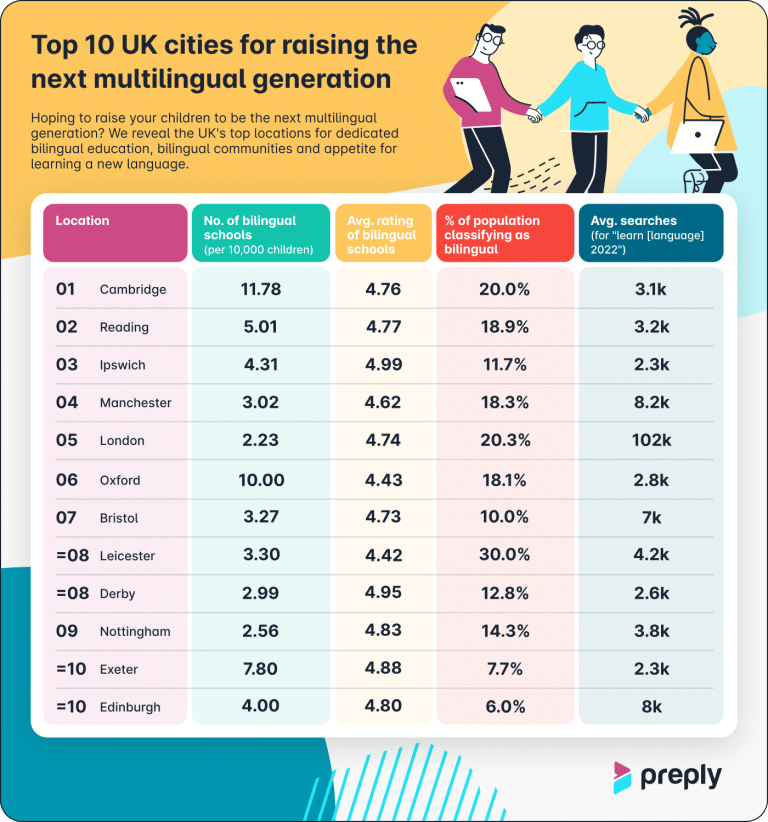
Taking over 110 UK towns and cities, international learning platform Preply has shown research predicting the UK hubs set to raise the next multilingual generation – Manchester has ranked fourth!

The study considers bilingual/international schools, local demand for learning a language and the size of the bilingual community (bilingual population), to reveal the country’s top locations for nurturing multilingualism.

Relevant highlights include:

  • Cambridge takes the crown and London fails to make the top three, placing in a respectable fifth place, whilst Reading, Ipswich and Manchester complete the top five respectively
  • Manchester’s top ranking is owed to its appetite for learning new languages, registering over 8000 searches in 2022 for “Learn X” across a variety of languages
  • Also to its merit, Manchester is home to the UK’s fifth largest bilingual community, as 18.3% of its population register as speaking more than one language
  • Manchester also places among the UK’s top ten for largest BSL-speaking communities, with 0.03% of its population being proficient in the language
  • In 2022 the most-searched-for language in Manchester was Spanish, followed by French and Arabic

One-third of Brits (36%) are bilingual but the world’s topmost bilingual nation Indonesia, where ¾ of the population speak a second language. With bilingualism/multilingualism being proven to have many social, psychological and lifestyle advantages, the benefits of having more than one language at our disposal are more than threefold.

For the full data set, you can visit Preply’s interactive tool HERE.

Ey Report Finds Manchester’s Economy Predcited to Be the Uk’s Third-Fastest Growing Between 2024 and 2026

According to EY’s latest Regional Economic Forecast, Manchester is forecast to see the third-fastest economic growth of all UK towns and cities between 2024 and 2026.

When measured by Gross Value Added (GVA), Manchester’s economy is expected to see annual average growth of 2.5% between 2024 and 2026, comfortably outpacing the national growth rate (2.1%). Only Reading (2.7%) and London (2.6%) are expected to see faster growth than Manchester.

The North West is expected to see annual average growth of 2% over the same period – a bounce back from the 0.7% contraction forecast for 2023.

Manchester is also expected to record the fastest rate of employment growth of any UK town or city from 2024 to 2026, with job numbers in the city forecast to grow 1.8% per year over the period. Meanwhile, UK jobs are expected to grow an average of 1.3% a year, and North West jobs are expected to be up 1.2% each year.

Elsewhere in the North West, Liverpool’s economy is forecast to see 1.9% annual average growth from 2024 to 2026 – marginally below the national and regional averages. Positively, the city is forecast to see job numbers average 1.3% growth per year between 2024 and 2026, in line with the national rate and slightly outpacing the North West average.

The North West is expected to have the fastest-growing economy in the North of England between 2024 and 2026, with the administrative & support services, and information & communication sectors set to play a key role for the region’s growth. Manchester’s positive outlook is supported by expectations for the professional, scientific & technical, and financial & insurance activities sectors. By 2026, GVA in Manchester’s local economy is expected to be £2bn larger than in 2022.

Stephen Church, EY’s North Market Leader, said: “The North is home to many of the UK’s most dynamic and innovative businesses and, while the next 12 months will be economically challenging, there are areas across the region where we can expect to see encouraging growth over the next few years. The North’s cities are set to be particularly strong performers.

“However, progress is about the whole of our region, not just our bigger cities. And while several towns and cities are expected to see better economic and employment growth than many other parts of the country, too many places are still expected to trail behind.

“In order to spread growth, not just throughout the country, but throughout regions too, it is critical that the public and private sectors work together to combine their expertise, strengths, and capabilities. The North needs both working in tandem to succeed.

“Looking ahead, the regions across the North need their own clear strategies for growth, which reflect each region’s own strengths and unique attributes. Getting the right sector mix is key, and investment in high-value sectors and skills can help build a sustainable future – not just for the North, but for the whole country too.”

Mixed expectations across the North West

Outside of Manchester and Liverpool, Chorley has reasons for optimism, with forecast average GVA growth of 2.4% per year between 2024 and 2026 – significantly outpacing the national average. Chorley is also expected to see higher employment growth than the national rate for the same period, with 1.4% annual average growth forecast.

Chorley’s prospects are expected to be particularly boosted by the town’s real estate activities and construction sector.

Warrington, Rochdale and Lancaster are all expected to see their economic growth only marginally outpaced by the regional and national rates, with an average of 1.9% growth per year forecast for each from 2024 to 2026. Warrington and Lancaster’s average annual employment growth rates are expected to keep pace with the regional average over the same period at 1.2%, while Rochdale’s is expected to be slightly slower (1.1%).

Carlisle, Blackpool, Wigan and Preston are among the towns expected to experience the most significant economic challenges in the North West, with average economic growth of just 1.5% each per year forecast from 2024 to 2026 – trailing both the national and regional averages.

Carlisle is also expected to have the joint-slowest employment growth in the North West from 2024 to 2026, along with Blackburn, with both forecast to see jobs rise by an average of 0.8% per year over the same period. Blackburn is expected to record average annual GVA growth for 2024-2026 of 1.7%.

The economic gap between London and the rest of the country set to grow again

The EY Regional Economic Forecast also says that the rising cost of living and weaker consumer spending are expected to deepen the economic divide between London and the rest of the UK.

The forecast says that UK Gross Value Added (GVA) is expected to decline 0.6% over the course of 2023, with London (-0.2%) the only part of the country predicted to see a smaller economic contraction than the UK overall. While Scotland is expected to match the overall UK GVA performance in 2023 (also contracting 0.6%), other parts of the UK are forecast to lag behind. Yorkshire and the Humber and the East Midlands are predicted to see the steepest GVA contractions, at 1% each.

Driving the contraction in UK output in 2023 are the forecast declines in services most dependent on household spending. With consumers struggling amid cost of living pressures, this year’s worst performing sectors are expected to include wholesale and retail (-3.3% GVA contraction), accommodation and food services (-2.7%), and arts, entertainment and recreation (-1.8%). Manufacturing (-2.9%), which relies on consumer spending to maintain demand, also faces challenges relating to higher input costs such as raw materials and labour, alongside increased borrowing costs.

At the other end of the spectrum, less consumer-dependent sectors like administrative and support services (0.8%) and professional services (0.1%) are expected to see some growth, while sectors like real estate (-0.2%) and financial and insurance services (-0.5%) are forecast to see smaller contractions than the rest of the economy.

Over the course of 2024-2026, UK GVA is expected to grow at an annual average 2.1%, with London growing 2.6%. The South East (2.2%), South West (2.1%), East of England (2.1%) and West Midlands (2.1%) are also forecast to outpace or match wider UK growth. Like London, the West Midlands and the South West are both expected to be boosted by strong growth in the information and communication sector, which is expected to be the UK’s fastest growing sector in the medium-term.

The pattern in GVA growth is reflected in jobs, with only London, Northern Ireland and Wales expected to perform better than the UK as a whole in 2023. Job numbers in these three areas are expected to be effectively unchanged this year, and down 0.2% across the UK. The West Midlands is forecast to trail the rest of the country, with job numbers shrinking 0.4%. London is also forecast to see the highest increase in its working age population in the medium term, with annualised growth of 1.2% between 2024 and 2026.

Rohan Malik, EY’s UK&I Managing Partner Markets & Accounts, says: “The rising cost of living is likely to exacerbate the differences in regional economic performance, widening regional inequalities and heightening the need for economic policy which spreads growth out across the UK. Levelling-up presents an opportunity to boost growth for the whole of the UK – but familiar patterns are still all too present as the economy recovers from the pandemic.

“London clearly enjoys advantages in economic resilience, skill levels, and in productivity – both in higher and lower skilled sectors. But London’s performance also offers lessons for the rest of the country. Sector composition is key for regional economic performance, for example. Regions need their own visionary sectoral growth plans that define roles for the private sector, alongside government, as investors, employers and economic agents in their regions. It’s also vital to unlock investment in skills and encourage labour retention.

“The key to nurturing a strong sector composition is investment in high value-added sectors, like advanced manufacturing and information and communication. The transition to Net Zero, for example, represents a generational opportunity to rebuild the manufacturing base, upskilling workers in new energy generation and operation capabilities across the value chain from construction of solar farms, heat networks and hydrogen pipelines to electric vehicles and charging infrastructure. A one-size fits all approach won’t work though, and regions need to understand their own strengths, weaknesses, and sub-sector opportunities.

“High value sectors won’t function without a high value workforce and, too often, regions struggle to retain and uplift their skill bases. Fixing this needs to be approached from several angles: graduate and skills retention relies not just on the development of well-paid jobs, but strategic planning on the broader set of social, environmental and structural components that determine the quality of life in a given region too.”

Region 2023 GVA Growth Region Annualised GVA Growth 2024-26
London -0.2% London 2.6%
Scotland -0.6% South East 2.2%
UK -0.6% UK 2.1%
East -0.7% South West 2.1%
Northern Ireland -0.7% East 2.1%
South East -0.7% West Midlands 2.1%
North West -0.7% North West 2.0%
Wales -0.8% Northern Ireland 1.9%
South West -0.8% East Midlands 1.9%
North East -0.8% Wales 1.7%
West Midlands -0.8% Yorkshire & the Humber 1.7%
Yorkshire & the Humber -1.0% North East 1.7%
East Midlands -1.0% Scotland 1.7%


Six & Flow Delivers New Outreach Strategy for Blackpool FC

Six & Flow delivers new outreach strategy for Blackpool FC

Following a competitive pitch, Six & Flow – the global growth agency which is headquartered in Manchester but that also has bases in London, Dublin, Toronto and South Africa – has developed and delivered a bespoke HubSpot-focused sales and marketing strategy that will drive all of the club’s future inbound activities.

The project saw Six & Flow lead an initial data mapping workshop that identified key areas of The Seasiders’ CRM tactics that needed be optimised, automated and better aligned to its core business functions. Focus was centred on supporting the club’s three main revenue drivers: hospitality on match days, commercial sales – including match day sponsors, and venue hire.

This was then followed by a comprehensive onboarding and training programme, including an end to end user journey workshop where all process and entry points to the CRM were carefully mapped out. The aim was to guide the club’s marketing and sales team on how to best implement and maximise the new Sales Hub Pro led strategy.

Blackpool F.C. was founded in 1887 and initially played its home games at Raikes Hall and then at the Athletic Grounds before moving to Bloomfield Road in 1901 where it remains today. The club was a founder member of the Lancashire League in 1889 and was invited into the Football League Second Division in 1896. The 2021–22 season was Blackpool FC’s 113th season in the English Football League, and it first season back in the EFL Championship after winning the EFL League One play-offs.

Rich Wood, managing director of Six & Flow, said: “The Seasiders is a football club with a first class pedigree and a legion of dedicated fans so it’s an honour for all of us at Six & Flow to help them maximise their revenue streams and drive engagement. Over the past couple of months, we’ve worked hard to build out automations to help with data cleansing and to empower the team with the tools that will help them target and nurture target accounts with an effective outreach strategy.”

Jonty Castle, chief revenue officer at Blackpool FC, added: “Right from the outset it was clear that Six & Flow understood our aims and how our business operates. They came to us with some innovative ideas that will be rolled out for the commercial and long-term benefit of the club.”